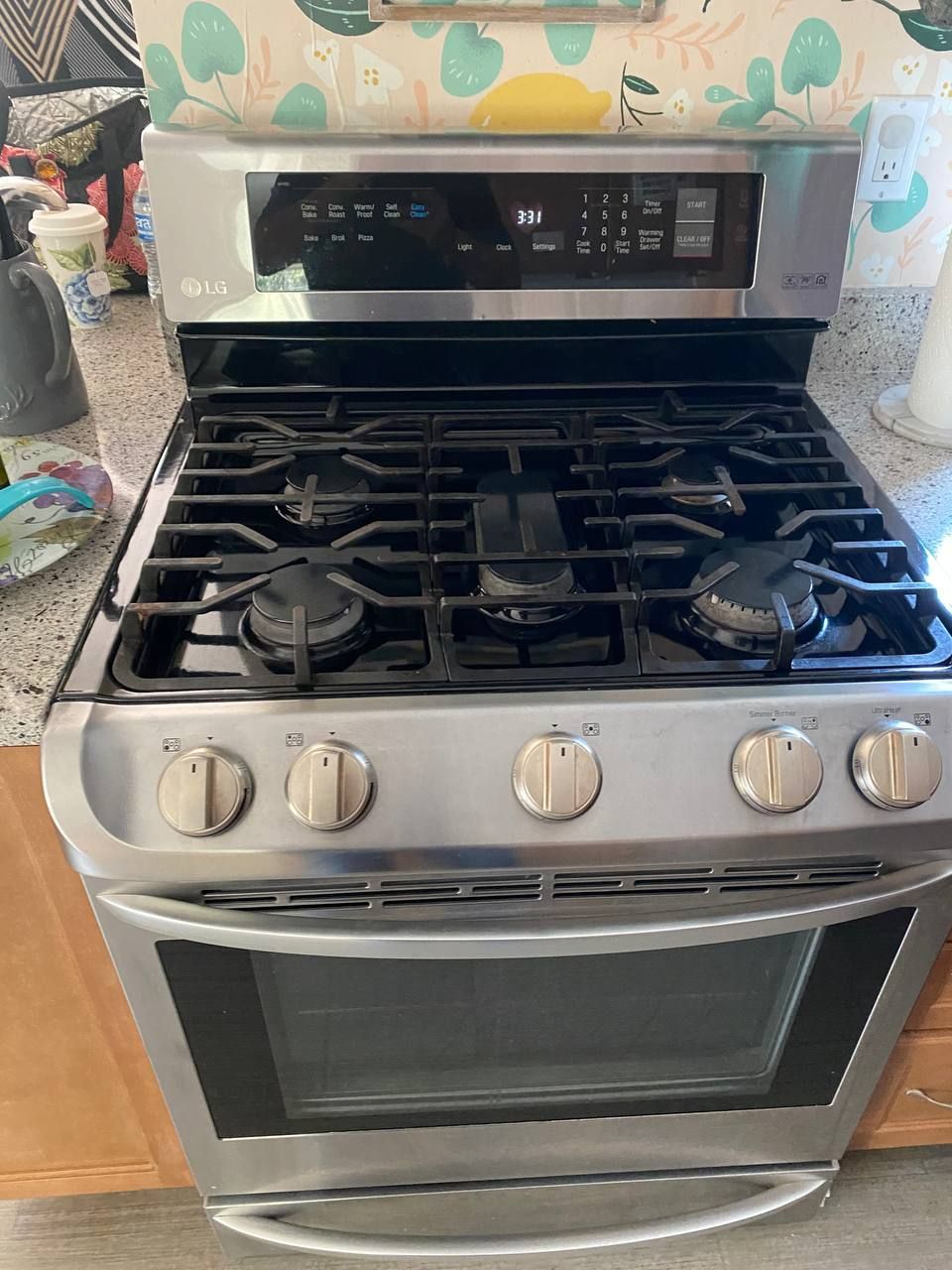
Gas cooking in our area comes in two forms. Bellingham, Ferndale, Lynden, Blaine, Everson, Sumas, Burlington, Sedro-Woolley and Deming have piped natural gas. Farther out, in places without gas mains, such as Kendall, Maple Falls and Glacier, a gas range almost always runs on propane from a tank. The troubleshooting is mostly the same for both fuels, and so is the first rule.
If you smell gas
Natural gas and propane both carry an added odor like rotten eggs. If you smell it, do not try to light a burner, do not flip switches or unplug anything, and do not use a phone indoors. Get everyone out and phone 911 from the street, or your propane supplier if you are on a tank. A brief whiff at the moment a burner catches can be normal; a smell that lingers is not.
How a gas cooktop lights
Each surface burner valve has a small switch behind its knob. Turning any knob to Lite closes that switch and tells a spark module to fire, and on most ranges the module sparks every electrode at once. That is why all four burners click when you light one. The spark has to jump from the electrode tip to the burner at the moment gas flows out of the ports. If any link in that chain is off, you hear clicking and see no flame.
Clicking, no flame
- Cap not seated. After cleaning, a burner cap sitting slightly off center leaves the spark nowhere to land and blocks some ports. With the burner off and cool, lift the cap and set it back flat.
- Wet burner. A boil-over soaks the burner head and electrode. Let everything dry completely, a few hours or overnight, before trying again.
- Clogged ports. Food and cleaner residue fill the small ports. With the range cool, clear them with a stiff brush or a straightened paper clip, not a toothpick that can snap off inside.
- No gas at all. If no burner and not the oven will light, the problem is upstream: a shutoff behind the range left closed after a move or remodel, or a propane tank that ran dry. After a tank runs empty, the supplier generally checks the system before it is relit.
- Spark in the wrong place. A cracked porcelain electrode sparks to the burner base instead of the cap. In a dim kitchen you can sometimes see it landing low.
Clicking that will not stop
If a burner keeps clicking after it lights, or the clicking goes on with every knob off, moisture has usually gotten into one of the valve switches, often after a spill or a heavy wipe-down around the knobs. Switch the range off at the breaker, give it a day to dry, and try again. If it still clicks, the switch or the spark module has failed and needs replacing.
Weak, yellow or lifting flames
A healthy natural gas flame is blue with a small, sharp inner cone. Yellow tips, soot on the bottoms of pans, or flames that lift off the burner and blow out point to dirty ports, a misaligned cap, or a range whose orifices do not match its fuel. A range set up for natural gas burns wrong on propane, and the reverse, and a used range or a home that changed fuels can end up that way. Incomplete combustion produces carbon monoxide, so stop using a burner that soots and have it checked. A carbon monoxide alarm near the kitchen and the bedrooms belongs in any home with gas appliances.
Cooktop works, oven does not
Gas ovens from the last few decades mostly light with a glow bar, the hot-surface igniter tucked under the oven floor. The igniter is wired in series with the oven's safety valve, and the valve opens only once enough current flows through the igniter. As an igniter ages it still glows orange, but it draws less current, so the valve opens late or not at all. You get an oven that takes far longer to preheat than it used to, or one that glows through the floor slots and never lights. It is one of the most common gas oven failures. The broil burner usually has its own igniter, so a working broiler with a dead bake burner points the same way. Some higher-end ranges use spark ignition in the oven as well, and those fail differently.
Never try to light an oven burner with a match. If the oven smells of gas while the igniter glows and nothing lights, turn it off, ventilate, and if the smell lingers, follow the steps above.
What we check on a visit
Our technician confirms that gas reaches the burners, checks the spark module and each switch, measures the oven igniter's current draw against what the valve needs, and inspects the valve, temperature sensor and control. Before the range goes back in place, we reattach the anti-tip bracket, which keeps a range from tipping forward if someone leans on an open oven door. Igniters and spark modules for common models ride along, so many ranges are cooking again by the end of the first visit. Your actual price comes on a written estimate after testing, ahead of any work.
Propane ranges along the Mount Baker Highway are regular work for us, since one of our technicians is based out that way; see our Maple Falls page for that corridor, our oven repair page for the rest, or call (360) 525-9166.