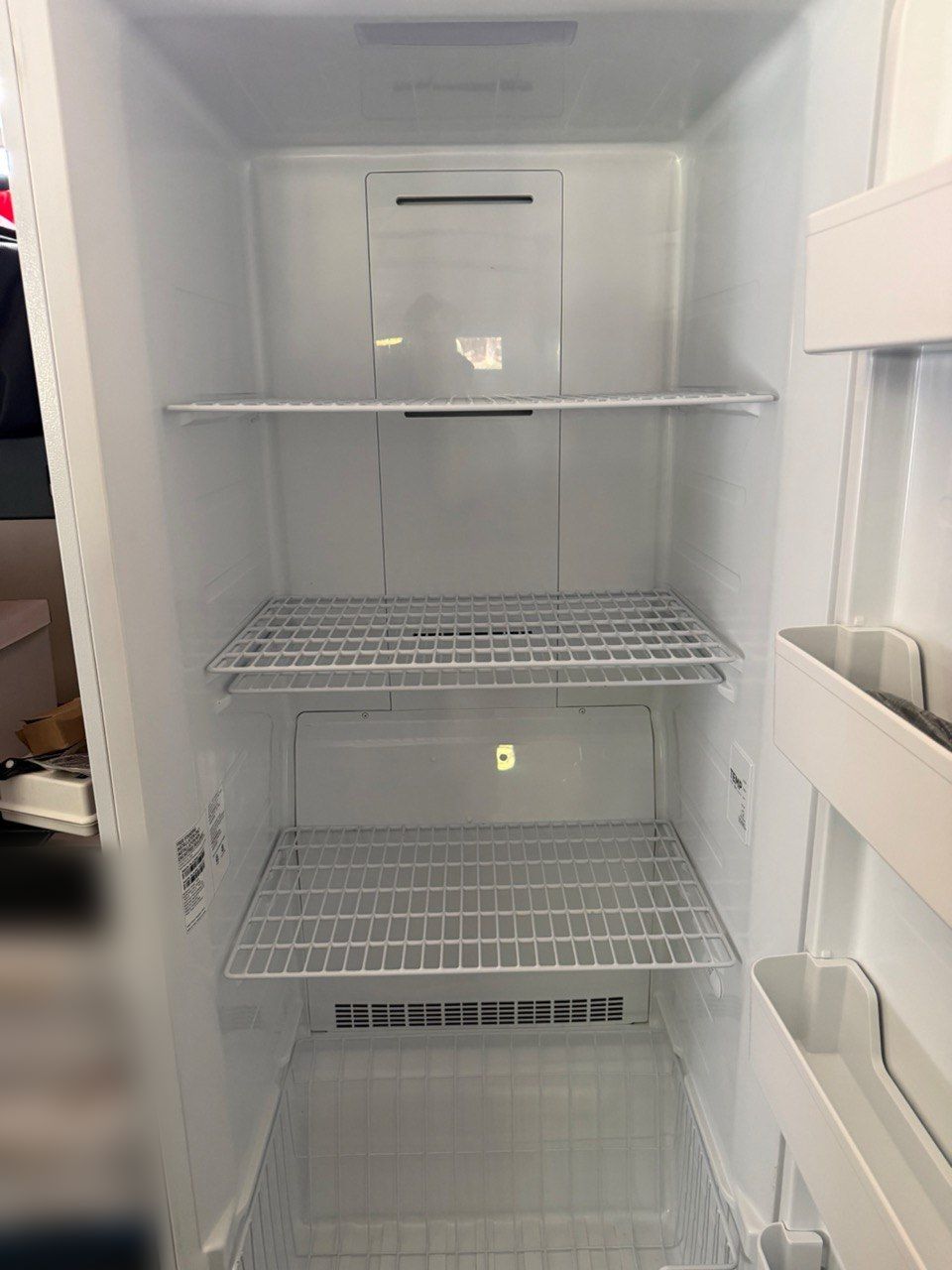
When wind knocks out power in Whatcom County, it tends to do it in bulk. During the January 2024 outflow storm about 5,000 households lost power late on a Thursday and roughly 2,000 were still dark the next morning, most of them in the flatlands north of Bellingham. Summer can be harder on a refrigerator still: Bellingham hit 99°F on June 28, 2021, the hottest reading on record there. Either way, the call that follows sounds the same. The lights are on again and the refrigerator is warm.
First, the food
USDA food-safety guidance gives a closed refrigerator about four hours without power. A full freezer that stays shut holds safe temperatures for about 48 hours, a half-full one about 24. Keep the doors closed while the power is out. Once it returns, check with a thermometer: perishables from the fresh-food side that sat above 40°F for more than two hours should go, and frozen food that still has ice crystals, or stayed at 40°F or below, can be refrozen. When in doubt, throw it out.
Give it time, then check the simple things
A refrigerator that sat warm for a day needs many hours to pull itself back down, and reaching full temperature can take most of a day. Before you assume the worst:
- Check the breaker, and if the refrigerator is in a garage or near a sink, the GFCI outlet, which can trip when power returns.
- Plug a lamp into the same outlet to prove the outlet is live.
- Look at the control panel. Many models keep their settings, but some reset to defaults or show a power-failure alert that you clear with a button press. Your manual says which.
- Make sure the doors close fully and nothing shifted against a door or an air vent inside.
- Listen at the back. A running compressor makes a steady hum; the fans make a soft whir.
Signs the outage did damage
Power does not always come back cleanly. Lines reconnect, surge and sag for a few seconds, and electronics take the hit. The patterns that point to real damage:
- Dark display, no fans, no sound. With the outlet confirmed live, this points to the main control board or the power supply section on it.
- A click from the back every few minutes, then silence. The compressor is trying to start and tripping its overload. The start relay is a common culprit and a quick repair. If the compressor itself has failed, replacing it is sealed-system work, which we do not take on in this area; we tell you right away and help you weigh that against a new refrigerator.
- Fans run, compressor never does. On variable-speed models, the inverter board that drives the compressor is particularly sensitive to surges.
- A burnt smell near the top or back. Unplug the refrigerator and leave it off until it has been checked.
The defrost problem an outage uncovers
Some refrigerators that seem to have died in an outage were already failing. A self-defrosting refrigerator melts the frost off its evaporator coil on a regular schedule, using a heater, a defrost thermostat or sensor, and a timer or control board. If one of those parts quietly fails, frost builds on the coil for weeks while the refrigerator keeps up, just barely. The outage lets that frost partly melt, and when power returns the meltwater refreezes into a solid block. Air stops moving from the freezer to the fresh-food section, the freezer stays fairly cold, and the fresh-food side warms up.
You can usually spot it:
- heavy white frost on the freezer's back panel, often thickest at the bottom;
- a buzzing or scraping from the freezer as the fan blade hits ice;
- a puddle below the crispers or ice across the freezer floor, from a defrost drain that froze.
Unplugging the refrigerator for a day with the doors open and towels down melts the ice and brings it back for a while, which more or less confirms the diagnosis. Lasting repair means replacing whatever failed: heater, defrost thermostat, sensor or the control running the cycle. Those are everyday repairs for our technicians, and the parts for common models usually ride along.
Protecting it next time
During a long outage, switch the refrigerator off at its breaker or unplug it, then turn it back on once power has been steady for a few minutes. That keeps the rough first seconds of restored power away from its electronics. A plug-in surge protector made for refrigerators is an option if your manual allows one. In Blaine and Sumas, the city runs its own electric utility, so report outages to the city.
What a visit looks like
Our technician checks the outlet and the cord first, then the control board's outputs, the start components, the fans and the defrost circuit, and tells you which one failed and why. Your exact price is on the written estimate after the diagnostic, and the call-out fee comes off the repair total once you give the go-ahead. Read more on our refrigerator repair page or the pricing page, or call (360) 525-9166.